
Change is a natural part of life — but it is not always easy to navigate.
Even positive transitions can bring uncertainty, tension, and a subtle sense of anxiety. You might notice yourself overthinking, feeling on edge, or struggling to relax without fully understanding why. What’s important is that these reactions are not random — they follow patterns.
This self-assessment is designed to help you understand how you personally experience anxiety during periods of change. By exploring your thoughts, physical reactions, behaviors, and relationships, you can begin to see what is really driving your response to uncertainty.
Start the Anxiety During Change Test
If you want to better understand your reactions and patterns, you can take the test below.
It takes only a few minutes and will give you a clear, structured overview of how you respond to change.
Why Change Can Trigger Anxiety
Change often removes something we rely on — even if we were not fully aware of it.
It might be a sense of control, predictability, identity, or stability. When those elements shift, your mind and body naturally try to adapt. For some people, this adaptation happens smoothly. For others, it creates tension that shows up in different ways.

You may find yourself imagining worst-case scenarios

Feeling restless or tense
Delaying decisions

Seeking reassurance from others more often than usual
These are not flaws — they are signals of how your system is trying to cope with uncertainty. Understanding these reactions is the first step toward managing them.
What This Self-Assessment Measures
This test looks at five key areas of how anxiety during change can show up:

Cognitive Anxiety & Catastrophic Thinking
This area explores how your thoughts respond to uncertainty. Do you tend to imagine negative outcomes? Do your thoughts spiral when things are unclear?

Intolerance of Uncertainty
Some people can sit with not knowing. Others feel strong discomfort when things are unclear. This section measures how difficult uncertainty itself is for you.

Somatic Anxiety (Body & Nervous System)
Anxiety is not just mental — it often shows up physically. This part looks at tension, restlessness, sleep, and how your body reacts during change.

Control & Avoidance
When things feel unstable, some people try to control everything. Others avoid situations altogether. This section captures those behavioral patterns.

Relational Anxiety
Periods of change can also affect how we relate to others. This part looks at your need for reassurance, connection, and emotional stability in relationships.
Each of these areas gives you a different lens on your experience.
How the Test Works
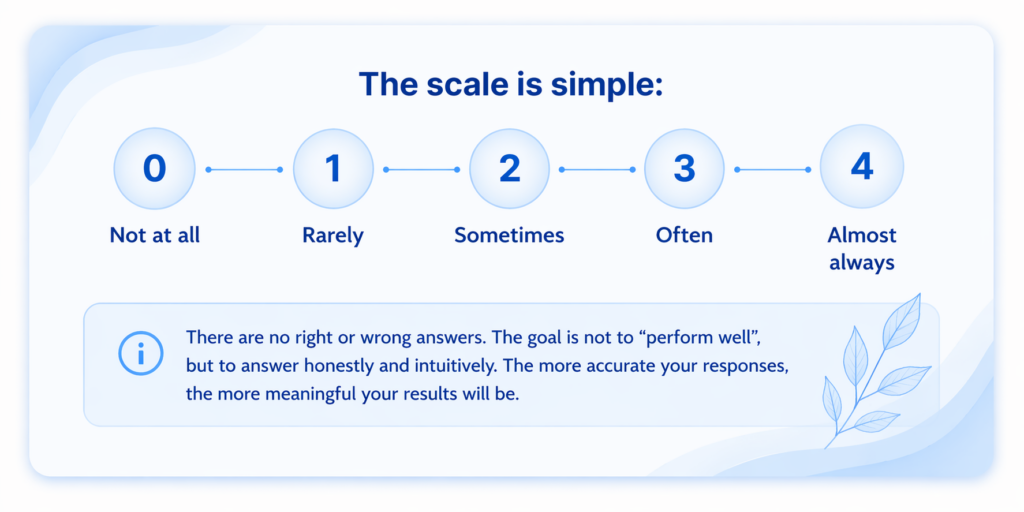
The assessment consists of 50 short statements.
For each one, you rate how much it reflects your experience over the past two weeks — especially if you are going through change, uncertainty, or transition.
What You Will Get From the Results
At the end of the test, you will receive a structured overview of your results. This helps you understand not just how much anxiety you experience, but also how it shows up and what may be driving it.
Each profile tells a different story.
You will see:
- your overall level of anxiety during change,
- your results across all five areas,
- a clear interpretation of what those patterns mean.
For example:
- your thoughts may be the main source of tension,
- your body may stay in a constant state of alertness,
- or uncertainty itself may be your biggest trigger.
Who This Test Is For
This assessment is useful if you:
feel anxious during periods of change or transition
struggle with uncertainty or lack of control
notice overthinking or difficulty relaxing
experience physical tension or restlessness

rely on reassurance or feel unstable in relationships during stress
Take a Moment Before You Begin
Before starting the test, it is worth taking a brief pause.
Find a quiet space if possible. Sit comfortably. Take a few slow breaths.
Try to shift out of “doing mode” and into a more reflective state.
This is not something to rush through — it is an opportunity to observe your own experience with a bit more clarity.Answer based on how things have felt for you over the past two weeks, rather than how you think they “should” feel.
Start the Test
When you’re ready, you can begin the assessment here: